Built for engineering, operations, security, and data teams who need to assess cloud readiness properly before anything moves. Covers the dependencies most organisations only discover once the project is already behind.
Scores across nine technical domains. Gives leadership an honest view of where the organisation stands – before anyone commits to a timeline they can't actually meet.
Domain-by-domain checklists with team ownership baked in. Security picks up the security items. Networking picks up the networking items. Nothing ends up as a catch-all on one overloaded workstream.
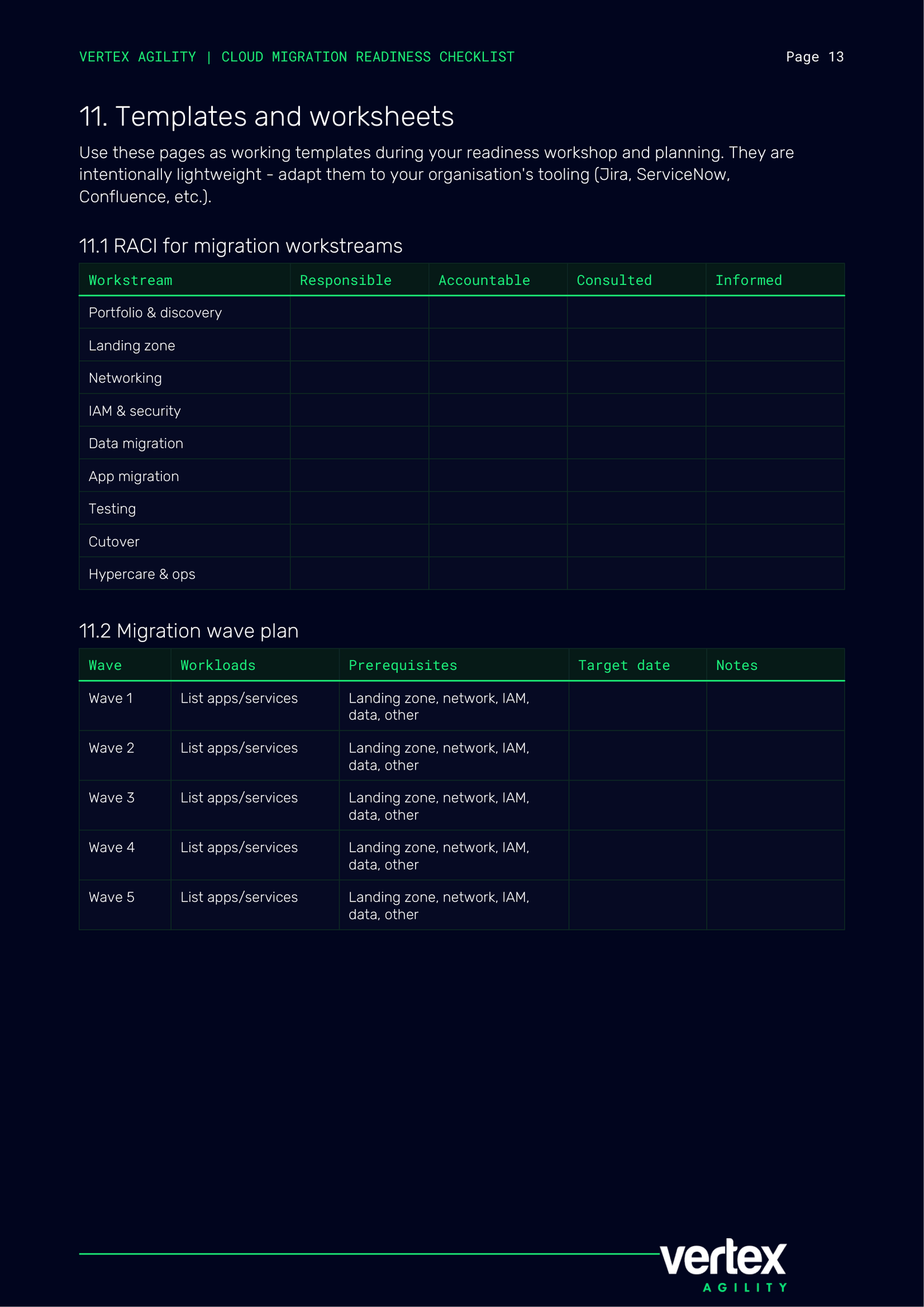
Dependency mapping templates, a wave planning worksheet, and a decision framework for the lift-and-shift vs. re-platform vs. re-architect call. The conversations nobody agrees on until they've already made the wrong choice.
Fill in the form. We'll send the checklist straight to you. No sequence, no campaign.
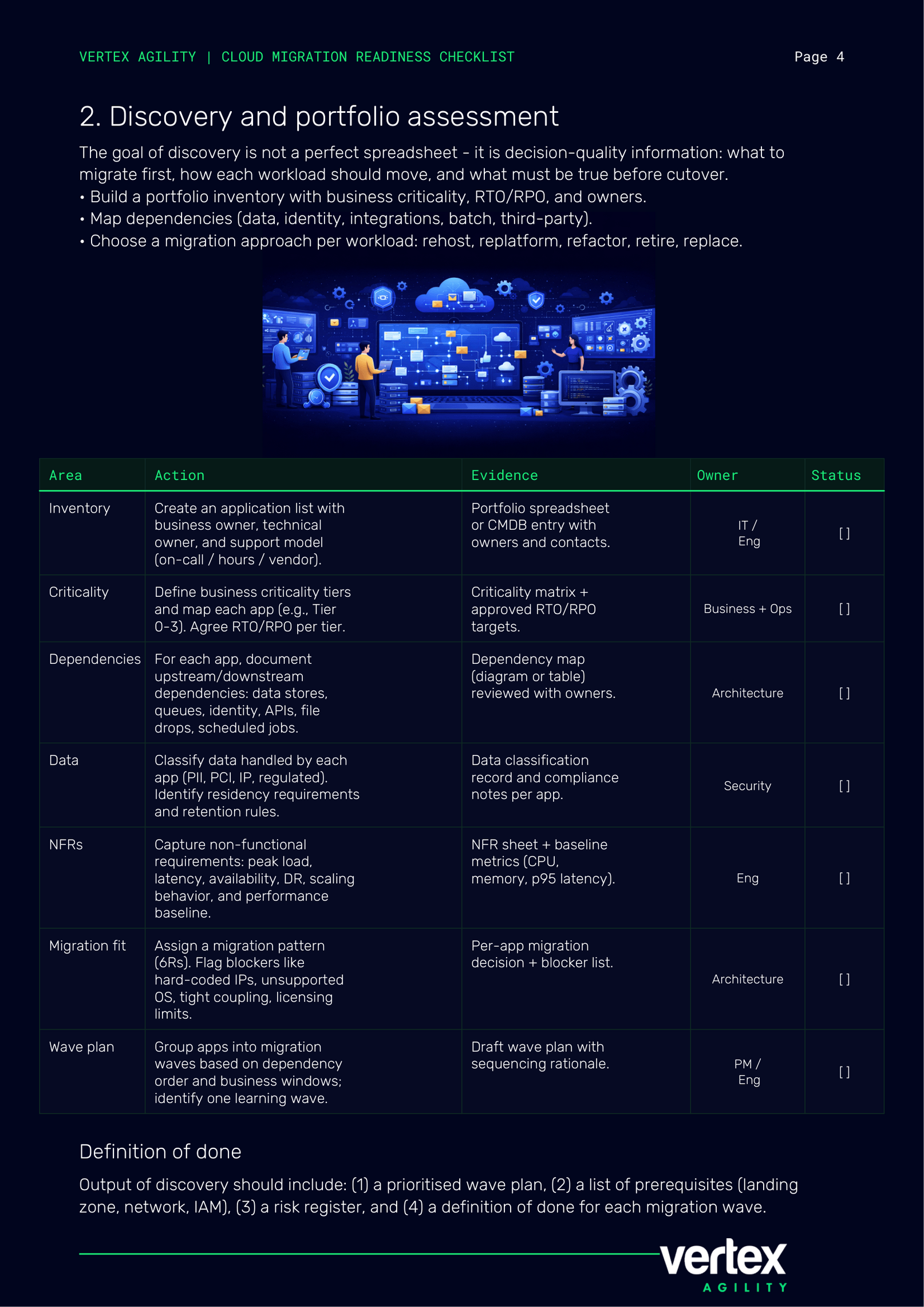
Application inventory, dependency mapping, and technical debt cataloguing. Most teams do this quickly. The checklist slows them down enough to do it properly.
Multi-account strategy, OU design, guardrail policies, and the baseline infrastructure that must exist before a single workload moves. Get this wrong and you'll be undoing it six months in.
Federation strategy, IAM design, privilege access management, and secrets management. Identity tends to be the dependency that blocks everything else – and the one nobody fully owns going in.
VPC/VNet design, hybrid connectivity options, DNS strategy, and firewall rule migration. The routing decisions that determine which workloads can actually move in which order.
Data residency requirements, database migration tooling, and encryption in transit and at rest. Legal will find these constraints eventually. Finding them first is cheaper.
Which workloads are worth containerising, moving to managed services, or going serverless – during the migration, while the work is already happening. Most organisations miss this window and have to come back for it.
Monitoring continuity, runbook migration, on-call handover, and the operational readiness gate before cutover. Day-two operations consistently get less attention than they deserve.
Performance baselines, regression testing, cutover procedures, and rollback validation. The acceptance criteria that separate a controlled cutover from a very bad Friday night.
Right-sizing, reserved instance planning, cost governance, and the 30/60/90-day agenda after things stabilise. The work that actually determines whether the migration was worth the disruption.
If it surfaces something worth talking through, our cloud engineers are easy to find. We won't pitch you – just a straight conversation about what you're planning.